
What is the Budget? Why is it so important? Why does it affect all of us? And, above all, how does one interpret the budgetary lingo flying around?

Hitting back at former prime minister Manmohan Singh for his criticism of the Modi government's handling of the economy, Finance Minister Nirmala Sitharaman on Thursday said he is more remembered for having brought India to "fragile five" and rampant inflation during his term.

Modi on the global stage always comes across as a statesman, counselling peace and amity to world leaders even as his policies at home hurt certain sections, explains Virendra Kapoor.

The International Monetary Fund (IMF) warned on Tuesday that India's general government debt (comprising both central and state government debt) could exceed 100 per cent of gross domestic product (GDP) in the medium term. It also cautioned that long-term debt sustainability risks are high due to the significant investment required to meet India's climate change mitigation targets. The Indian government, however, disagreed, arguing that risks from sovereign debt are extremely limited as it is predominantly denominated in domestic currency.

Foreign Portfolio Investors' (FPIs) selling spree continues as they pulled out over Rs 3,400 crore from the Indian equity markets in the first three trading sessions of November on rising interest rates and geopolitical tensions in the Middle East. This came after such investors withdrew Rs 24,548 crore in October and Rs 14,767 crore in September, data with the depositories showed. Before the outflow, FPIs were incessantly buying Indian equities in the last six months from March to August and brought in Rs 1.74 lakh crore during the period.

In 1930, John Maynard Keynes predicted that by 2030 technology would be so advanced that three hours of work per day would suffice. Has AI brought about the transformation that Keynes predicted, asks Atanu Biswas.

Overall, the Brazil, Russia, India, China and South Africa gap has widened as developed economies are taking the lead.

Secularism for India does not mean being non-religious but an equal respect to all faiths, but the "appeasement" government policies of the past made the biggest religion of the country feel like it had to be self-deprecatory in the name of equality, External Affairs Minister S Jaishankar has said.

If the war in the Israel-Gaza region escalates into a larger West Asian conflict, it could pose problems.
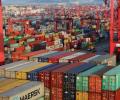
The decline in exports is mainly on account of poor demand in India's key destinations -- the Europe and the US -- and it may take some more months for the situation to improve. The demand scenario is "not looking very good as far as Europe is concerned, and the US also we have seen a decline in demand. "For the next 2-3 months, I think the demand scenario does not look very optimistic," DGFT (Director General of Foreign Trade) Santosh Kumar Sarangi told reporters.

Focused implementation of 'test, track, treat' strategy by the Union and state and Union Territory governments, ramped up hospital infrastructure and testing facilities, and emphasis on treatment of the hospitalised patients through the standard of care protocol advised by the Centre have effectively ensured that mortality of COVID-19 patients is contained, the ministry said.

In an economy that is slowing down, invest in defensive sectors to bring stability to your portfolio.

External Affairs Minister S Jaishankar on Wednesday took a critical view of some of the key decisions made by the Jawaharlal Nehru government, and said one needs to get out of this "cult worship" that the period from 1946 onwards was "great years" and the country did "splendidly".

Although the credit for acquiring the technological skill must be given to India's outstanding nuclear scientists, the decision to go nuclear was a political one that entailed clarity of vision, courage and resolve, points out Rup Narayan Das.

There is one billionaire for every three million people on the planet.

India must be prepared to deal with climate disasters, geopolitical confrontations, and social strife linked to global events, asserts Jayant Sinha, chairman of Parliament's Standing Committee on Finance.

Fresh from posting 399 in their previous game, South Africa batting was on fire yet again at the cost of Bangladesh who endured a 149-run rout.
A Reserve Bank of India-constituted internal group has recommended that interest income from NRI deposits may be taxed like domestic deposits consistent with current account convertibility. \n\n

India, along with Southeast Asian countries such as Indonesia, is expected to sustain growth in the medium-term in Asia region, replacing China as the key growth driver, Morgan Stanley and Nomura said in two separate reports released on Monday. While Morgan Stanley projected a 6.2 per cent gross domestic product (GDP) growth forecast for India in FY24, Nomura estimated the Indian economy to grow at 5.9 per cent in 2023. "Even with a slowing China, we expect GDP growth in Asia to sustainably outperform other emerging markets and the US. India and Southeast Asia are set to be the fastest-growing economies this decade.
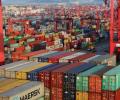
India's exports dipped after a gap of four months in March but finished 2017-18 with a healthy rise of 9.78 per cent to $302.84 billion.

'...similar to the 2008 global financial crisis, the 2012 taper tantrum, or the 2018 midcap crash.' 'This could lead to a substantial decline in activity and revenues for the broking industry.' 'When this will happen is uncertain, but as brokers, we must be prepared for such a downturn.'

Stock markets this week would take cues from global trends, the announcement of domestic macroeconomic data such as GDP numbers and foreign fund movement, analysts said. Besides, monthly auto sales and Purchasing Managers' Index (PMI) data for manufacturing and services sectors would also influence trading in the market, they added. Benchmark BSE Sensex tumbled 1,538.64 points or 2.52 per cent last week amid concerns that the US Federal Reserve might raise interest rates further to curb inflation.

Global gold demand hit an 11-year low in 2020 at 3,759.6 tonnes, mainly due to a weak October-December quarter and the COVID-19 related disruptions across the world driving a muted consumer sentiment throughout the year, the World Gold Council (WGC) said in a report. The overall consumer demand during 2019 was at 4,386.4 tonnes, while in 2009 the overall demand was at 3,385.8 tonnes, according the WGC's 2020 Gold Demand Trends report. Global gold demand dropped by 28 per cent year-on-year (YoY) to 783.4 tonnes in the fourth quarter compared to 1,082.9 tonnes during the October-December period of 2019, the report stated.

Though global IT services spending is likely to cross the $1-trillion mark to reach $1.031 trillion, growth rate will slow to 3.8% in 2019, compared to 6.7% last year according to reports

'The Weather Channel argues that India faces the gravest challenge: Climate change-induced health vulnerability.' 'This is an issue often neglected, alerts Claude Arpi: "Prolonged summers, unpredictable rains, floods, droughts, and rising sea levels are the harsh realities of climate change in the country. These factors increase the frequency and severity of illnesses, pushing people into poverty, and forcing migration".'

Some global weather watchers have warned that India will likely see below-normal rainfall during this coming monsoon -- and that should be taken seriously, regardless of whether it turns out to be true or not.

Flagging higher fuel prices in many opposition-ruled states, Prime Minister Narendra Modi on Wednesday called it "injustice" to people living there and urged the governments there to reduce VAT in "national interest" to benefit the common man. Modi raised the issue of many states not adhering to the Centre's call for reducing the Value Added Tax (VAT) on petrol and diesel after his government slashed excise duties on them in November last, and asked them to work in the spirit of cooperative federalism in this time of global crisis. Higher prices in some states were also harmful for neighbouring states, he added.

'India is likely to do better than other emerging markets.'
"We are maintaining our forecast of eight per cent growth for the current financial year despite the dwindling global economic scenario," Dun & Bradstreet India Chief Operating Officer Kaushal Sampat said. The global credit crisis might have slight impact on the Indian economy, but there would not be any significant impact as the financial institutions in the country were insulated, and regulators should be given credit for this, Sampat added.
Rupee has sharply fallen from 52.88 levels one month ago to 55.16 on Friday.
There has been a lull in the primary market scenario across the world, with the global IPO value registering a decline of 95 per cent at $1.6 billion so far this year.
The current sky-high price of oil at $50 a barrel has been caused due to stockpiling by various countries, said Ged Davis, managing director, Centre for Strategic Insight, World Economic Forum, in New Delhi on Wednesday.

Global rating agency Moody's on Monday said the high commodity prices and supply chain disruptions due to further escalation in the Russia-Ukraine crisis could expose about 42 per cent of rated Indian companies to significant risks. They are mainly in the oil and gas and automotive sectors. The impact may be seen under two scenarios: first, revised base line and second being downside economic scenarios incorporating a global recession and a more severe liquidity squeeze, it said. The military conflict between Russia and Ukraine is impacting companies in Asia Pacific, adding to existing challenges from supply chain disruption and the coronavirus pandemic.
Acknowledging the growing importance of Indian companies in the global scenario, London Stock Exchange has created a new post for business development for India and may also set up an office in the country.
J&K Finance Minister Muzaffar Hussain Beig said this step would, among other things, help ease tensions between India and Pakistan.

The value of foreign portfolio investment (FPI) in Indian equities was at $542 billion in the March quarter of 2023, a decline of 11 per cent from the preceding year, largely due to the exodus of foreign money from the domestic market, according to a Morningstar report. In comparison, the value of FPI in Indian equities was $612 billion in the January-March quarter of 2022. On a quarter-on-quarter basis, the value of FPI in Indian equities fell by 7 per cent from $584 billion recorded in the three months ended December 2022.

Equity markets will be driven by the outcome of the US Federal Reserve's interest rate decision this week, analysts said. Moreover, equity benchmarks will also continue to be guided by foreign fund movement and trend in Brent crude oil, they added. "The global markets are looking nervous after the US inflation numbers, which have caused the dollar index to hover around 110," said Santosh Meena, head of research, Swastika Investmart Ltd. Now everyone is eyeing the outcome of the upcoming US Federal Open Market Committee (FOMC) meeting.
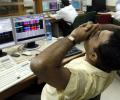
Stock market investors became poorer by Rs 8.30 lakh crore as equities continued their slide for the sixth consecutive day on Friday. The BSE Sensex has tumbled 1,855.58 points or 3 per cent since February 16. During this period, the combined market capitalisation of BSE-listed firms has tanked Rs 8,30,322.61 crore to reach Rs 2,60,00,662.99 crore. "The domestic market is broadly demonstrating a lack of confidence, registering its sixth consecutive day of losses despite global markets turning green.
